
From idea to pitch, a company is born in class.
Each team comes in with its own idea, real or invented. The game builds a fictional market around it, with customers to win over and competitors that won’t wait. The team tests its idea, builds its model, raises its funding and launches its company. In the end, it defends it before a jury, as it would before an investment committee.
A thirty-day trial access, open to a teacher or a trainer, to play a game at your own pace against virtual teams.
A team’s journey
The journey follows the path of a young company. The idea first faces its customers, then takes shape as a costed model. Then come the market periods, where the company sells, hires and keeps its cash in check, and finally the pitch.
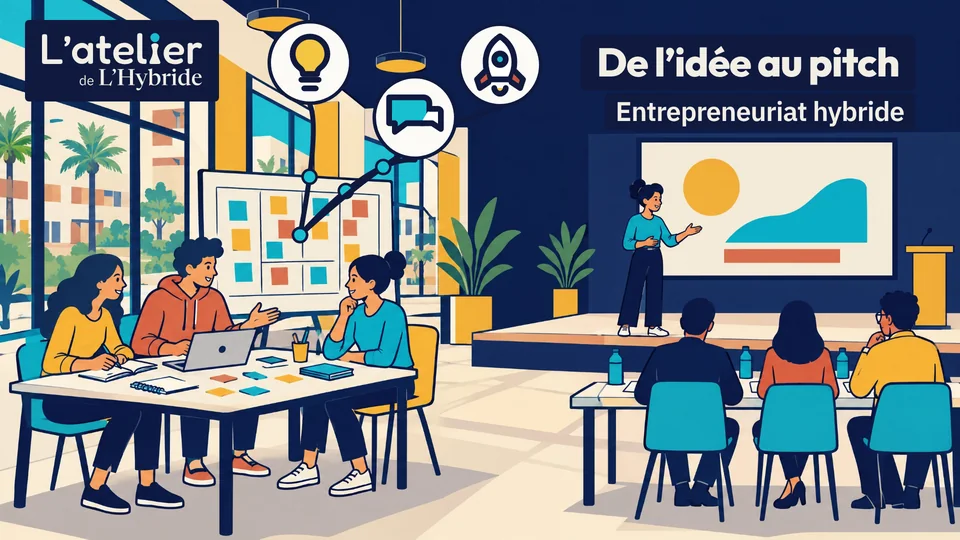
Hybrid entrepreneurship
The idea, put to the test
The team describes its idea, says who it sells to and at what price, then picks its type of business. The game builds a fictional market around it, with its customers, competitors and seasons. The team interviews simulated customers and sorts its assumptions, confirmed or disproved.
- Tools
- Customer interviews, Assumption board
- Deliverables
- The idea sheet, The interview log
The model and the funding
It fills in its canvas, works out its cost price and break-even point, writes its forecast, then pulls its funding together from personal contribution, loan, grant and investors.
- Tools
- Model canvases, Forecast and funding
- Deliverables
- The canvas, Unit cost and break-even point, The financial forecast, The funding plan
The launch
Period after period, the company sells, hires, watches its cash and compares its forecast with the actual figures. At the planned period, the team chooses to pivot or persevere.
The pitch
The team uploads its deck and defends its company before a jury gathered in the room, which you can widen with jurors invited through a link, or before simulated investors. Every juror grades with the same rubric.
- Tools
- Pitch
- Deliverables
- The pitch deck
Types of business
The team files its idea under one of these types, which sets how its company produces and sells.
Selling products online
Natural cosmetics, accessories, local produce, fashion.
Venue or appointment-based service
Salon, fitness studio, coworking space, guesthouse, lessons.
Business services
Agency, consulting, training, maintenance, corporate catering.
App or subscription service
Booking app, monthly box, software for shopkeepers.
Food and drink
Café, takeaway kitchen, food truck, delicatessen.
Manufacturing and crafts
Furniture workshop, ceramics, textiles, cosmetics made on site.
Tech startup
Mobility platform, budgeting tool, food-waste solution, connected device.
Formats
The format sets the length of each stage and the decisions that open up. In class, the teacher chooses whether each team plays on its own market or the whole class shares one sector.
A one-day intensive
In the morning, the idea meets its customers and takes the shape of a model. In the afternoon, the company lives through two market periods, then each team takes the stage for its pitch.
Three to five classes
One class to test the idea, another to build the model and the funding, then the market periods, the choice to pivot or persevere, and the pitch to close the module.
Self-paced
The founder moves at their own pace, or follows the cohort’s calendar. The game suggests a grade for each deliverable, simulated investors hear the pitch, and the trainer takes over whenever they wish.
Deliverables and grading
Each step leaves a written record, from the idea sheet to the pitch deck. The game reads each deliverable and suggests a grade with its reasons. You approve or adjust it, writing down your own reason, and the team receives your comments.
The grade rests on the approach, the market, management and finance, and the pitch. You set how much each part counts when you create the session, and the final word is yours.
Approach
Interviews, assumptions, canvases, financing plan.
Market
Period results and milestones reached.
Management and finance
Cash, profitability, forecast.
Pitch
The defence before the jury.
Who this module is for
Schools and universities
An entrepreneurship or business creation module, at bachelor’s or master’s level, played in class with the teacher.
Discover Schools and universitiesCompanies and training
A business creation course, in a training organisation or a company, led by a trainer.
Discover Companies and trainingIncubators and support programmes
An incubator, a foundation or a chamber of commerce that opens a programme to its cohort of founders.
Discover Incubators and support programmes
The game’s market, legal structures, grants and financing terms are fictional and simplified. The game trains people to decide. It does not predict the future of a real business, and it replaces neither a market study nor legal or financial advice.
They trust us





A quote for this module
Tell us how many teams or founders will follow the track, the format you have in mind and your calendar. We will send you a proposal.