
In teams, your students run companies fighting over the same market; you run the game.
The game grows out of L’Hybride, the book by Ayoub El Machatt.
The game calculates the results, prepares the reports and suggests the grades. You decide the pace of the rounds, the market’s twists and the assessment.
During the session
Set the pace
You open and close the rounds, set the timer, add minutes or pause the game.
Shake up the market
You throw in a twist at the moment you choose, for the whole class or for a single team, be it a price war, a stock shortage, a wave of bad reviews or a backlash over a chatbot.
Observe
You follow each team and can watch its game exactly as it sees it, without touching a thing.
Fill out the market
Virtual teams, bearing the scenario’s fictional brand names and run by AI according to a playing profile, can join the class. They bring more competition, and a yardstick for gauging the overall level.
Project
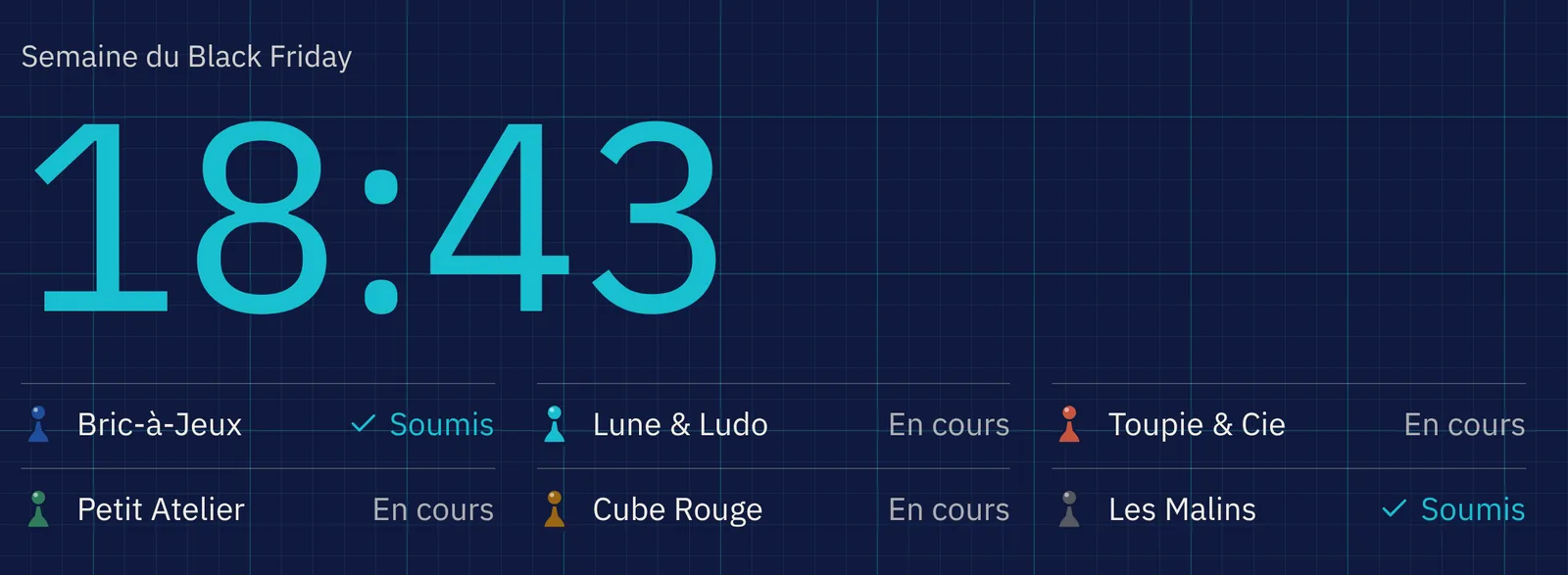
The classroom screen shows the timer, the market news and then the ranking.
Grade
For each team, the game suggests a justified grade, criterion by criterion. You approve it or adjust it, with your reason.
A twist, at the moment you choose
Every scenario comes with its own market events. You choose when to launch them, and for whom. The news appears on the teams’ screens and on the classroom screen, then weighs on the round’s results.
Dashboard · Round 2
Market event
- An e-commerce giant slashes toy prices.
- This Christmas’s star toy is out of stock.
- A wave of bad reviews hits a shop in the market.
Trigger for the whole class
Toupie & Cie’s team screen
Market news
An e-commerce giant slashes toy prices.
Discounts of 40% announced on the best-selling brands until the end of the month.
Market share, previous round
- Toupie & Cie24%
- Les Malins21%
- Trombia.ma31%

A justified grade, approved by you
Every round, the game suggests a grade out of 100 and explains each criterion. The engine calculates performance, budget efficiency and targeting. AI reads each team’s writing (published content, the rationale for its objective, its decision memo) along with the visuals of its Meta ad and callback request page, and suggests the scores for content quality and for reading the indicators, each with its reason. It also writes each round’s report from the engine’s figures, with no figures other than those.
The weights below are the default ones. You set them when you create the session.
- Performance against the chosen objective35
- Budget efficiency20
- Content quality20
- Targeting relevance15
- Reading the indicators and reacting10
What they learn by playing
Your students learn to decide, by setting an objective and weighing up a budget, and then to execute, from the Meta audience to the callback request page. Every round has them go back over the figures, react to the market and choose what to hand over to AI.
The learning outcomes in detailDesigned by a practitioner who teaches
Ayoub El Machatt teaches marketing, a profession he practises. He founded Wave Digital Agency and has led it for more than eleven years. In Morocco, France and abroad, he has supported more than 60 organisations, from start-ups to SMEs and retail brands, from their digital transition to the adoption of AI. He is also the author of L’Hybride, the book the game is built on.
That double profession shows in the game. Decisions are made as they are in business, with a budget that counts and competitors across the table; the lessons come after the round, once your students have had time to get things wrong.

After the session
Content scoring grids
Item by item, the score suggested by AI and its reason. You adjust it by writing down why.
End-of-session awards
Best ad, sharpest reading of the indicators, costliest trap. The game suggests, you confirm.
Reports and exports
A report for each team, emailed to every student, and an export of the grades for your spreadsheet.
L’atelier opens to your institution through an annual licence, priced on request. Each teacher at the institution then receives a personal invitation.