Run a company before you even have one.
One still looking for its place in a market, or one a team invents from a single idea.
- Market scenariosRun a companyThe team takes over an existing company and goes after its customers, from the shop window to online ads.
- From idea to pitchStart your ownThe team starts from its idea, tests it with customers, funds it, then defends it before a jury.
A thirty-day trial access, open to a teacher, to play a game at your own pace against virtual teams.
Are you a student? Join a class.
They trust us





For institutions in Belgium.
In class, each team takes charge of a company and defends its customers against the others. Each class picks the market of its module, from a toy shop, a gym, a language centre or a hotel. The institution takes the licence, and students enter the game with a code.
L’atelier de L’Hybride is a business game. For a single class or a whole module, your teams make a company’s decisions, and a fictional market answers back, period after period. You run the game, from its pace to the grades.
Run a company, or start your own
Running an existing company
A toy shop before the holidays, a language centre at the start of term, a medina workshop in spring. The team inherits a company and its market, sets its strategy, then spreads its budget across the shop window, ads, social media and the website. Each period the results come in, and the other teams in the class are after the same customers.
The festive season
Toy shops
All year round
Language centres
From back-to-school to summer
Gyms
A year in Marrakech
Hotels
Tailor-made
Create a tailor-made scenario
Request a quote
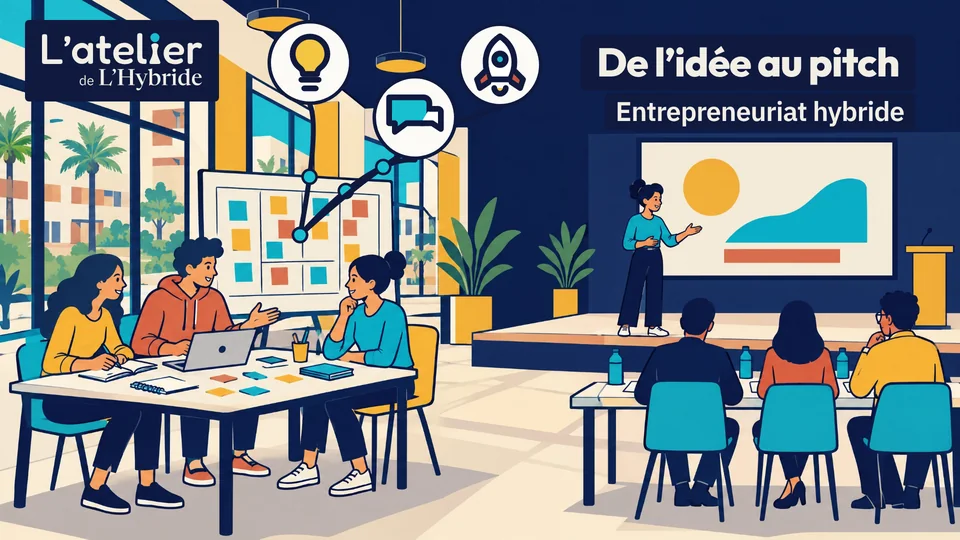
Starting a company, from idea to pitch
A team arrives with its idea, and the game builds a fictional market around it. The team interviews simulated customers, raises its funding, opens its doors, then defends its company before a jury.
Hybrid entrepreneurship
From idea to pitch
Every idea gets its own market, with its customers, its competitors and its seasons, whether it is a café near campus, a ride-sharing app or a ceramics workshop.
From idea to pitch in detailWhere to start in your own setting
Schools and universities
In marketing as in entrepreneurship, your students play in class and you lead the session.
Discover Schools and universitiesCompanies and training
A cohort of managers or a group of future founders, with a trainer who sets up the session.
Discover Companies and trainingIncubators and support programmes
A cohort of founders, following your programme’s calendar or each at their own pace.
Discover Incubators and support programmes
Your class, from brief to podium
For each session you set the number of periods, their length and the tools that open in each. The class then fits into a tight half-day, or takes the whole day, at your own pace.
Preparation
The brief on the table
It all begins like a first meeting with a new client. Teams discover their market and give their company a name. Then they set their strategy, from the objective to the price, by way of the customers and the ground to win from the others. You go from table to table.
- 1
Period 1
The first campaigns
The period opens on a street coming to life on screen, in the colours of the season. Then the timer starts and the budget looks for its place across the channels. Teams write their first ads, and the project lead sends in the decisions before the last second, with a few lines to defend them.
- 2
Period 2
The first verdict
Results land on every screen, ad by ad, with what each one cost and what it brought in. Teams revisit their strategy and their campaigns as new tools open up. And at your signal, the market has a surprise in store for them.
- 3
Period 3
The final period
Two reports in hand and the competitors’ ads in mind, teams split their budget one last time. They know their market far better than in the first period, and they have just one chance left to show it.
- End
Debrief
The podium
The ranking goes up on the big screen. Then comes the conversation, about the mistakes that cost dearly and the hunches that paid off. The grades can wait for later, when you have a clear head.
A team’s report after period 1 (demo data)

You stay in control
On both paths, the game publishes the results, prepares the reports and suggests the grades. The tempo is yours, and so is the final word on every grade. Mid-period, for instance, you can set off a price war just as the teams thought they had found their rhythm.
Dashboard · Period 4
Market event
- A national chain slashes its prices before the summer.
- Members complain about a gym on its business profile.
- A gym’s chatbot answers go viral on social media.
Trigger for the whole class
Best Fit’s team screen
Market news
A national chain slashes its prices before the summer.
It announces 40% off the summer membership and a strong online campaign across the city.
Market share, previous period
- Best Fit15%
- FitGym16%
- AeroBell13%
- Studio Nour9%
A system to steer
A campaign never lives on its own. The customer notices a video one evening, browses the website the next day and walks into the shop on Saturday. Each team runs that whole journey, and adjusts it period after period.
- 1
Objectives and strategy
A justified objective, customers, a positioning, products to feature and a price, revisited every period.
- 2
Media plan
The period’s budget, split across the channels to serve that strategy.
- 3
Campaigns and content
The shop window, ads, posts, videos, messages and website speak to the chosen customers and all say the same thing.
- 4
Results
The real return of each channel, read in Analytics.
- 5
Adjustments
The team moves its budget around and fixes its campaigns.
The tools of the trade
Your teams work in tools that keep the logic and vocabulary of the real ones, from the shop’s till to Google Ads keywords, from TikTok videos to WhatsApp messages, from customer reviews all the way to the website. And when the company chooses to, AI takes on its share of customer support, content or market watch.
My shop
The neighbourhood shop welcomes its customers at the counter. The team dresses its window for the season, chooses what to put forward, invites customers to a workshop or a demonstration, and places QR codes by the till that carry the visit on to a review, a conversation or an account to follow. Depending on the scenario, the place becomes a gym, a language centre or a hotel, with its front desk, its timetable and its prices.
My shop · Till and store management
Window and featured items
- Early-learning toys
- Board games
- Arts and crafts
This period’s event
Arts and crafts workshop
An hour of crafts for children, with a shop assistant.
QR codes at the till
- Google reviews
- TikTok
Receipt
Thank you for visiting Toupie & Cie
Scan to leave us a review
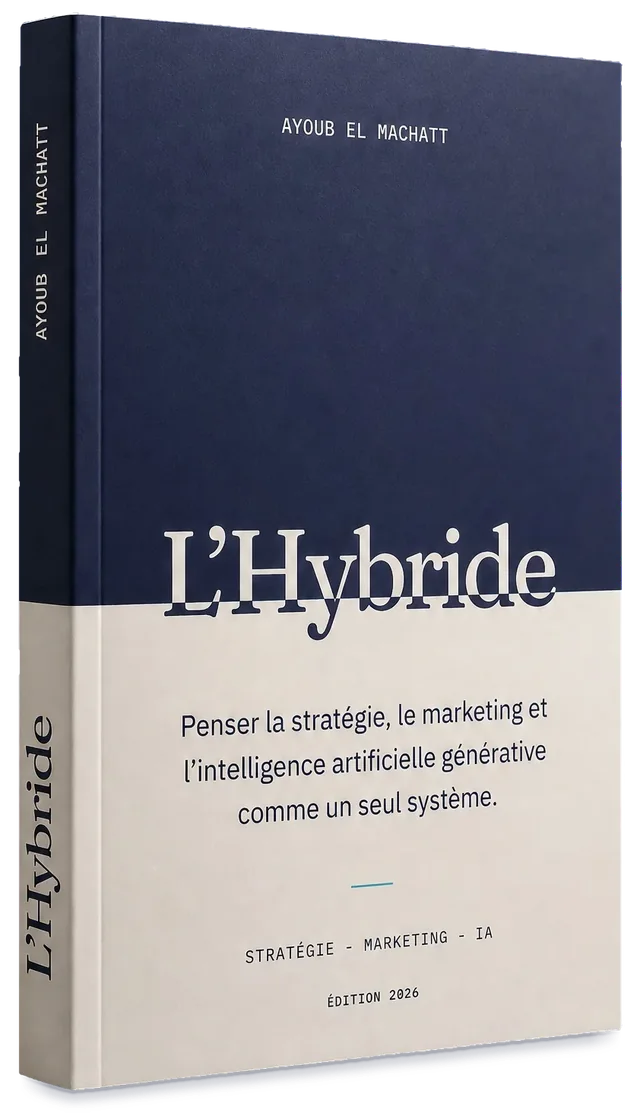
Born from a book, L’Hybride
The marketing path is built on L’Hybride, Ayoub El Machatt’s book, which invites readers to think of strategy, marketing and generative artificial intelligence as one system. Here your teams live the book’s ideas, with a budget to defend and a timer that will not wait for them.
Ayoub El Machatt teaches marketing and runs Wave Digital Agency, the agency he founded.
Frequently asked questions
Bring L’atelier to your teams
A school opens L’atelier to its classes through an annual licence. A company, a training organisation or a support programme opens it to its groups on a quote. Tell us what you have in mind, and we will send you a proposal.
Already invited? Sign in.
A thirty-day trial access, open to a teacher, to play a game at your own pace against virtual teams.